

UAE is popularly known for its international workforce, diverse economy and business friendly environment. You should know that the country’s tax system attracts the residents, investors, entrepreneurs and international businesses. Here, individuals do not have to pay personal income tax on their salary business or consumers but it does not mean that UAE is completely tax free.
Under the tax system of UAE, Corporate Tax, Value Added Tax, Custom duties, sector specific charges and certain local taxes are included. If you are living in UAE or planning to move then it is essential to understand about UAE Tax.

In this article, we are providing detailed information about UAE Tax. But you should know that rules can change at any time. The information which is given in the article reflects the current UAE rules and official guidance. It is only a general guide which should not be used as a individual tax advice.
What is a UAE Tax System?
Currently, the UAE’s federal tax covers the VAT, Excise Tax and Corporate Tax. According to official UAE Government Portal, custom duties as well as other charges are a part of the financial and taxation environment.
The most important feature of UAE is that it does not levy personal income tax on individuals. So, employees do not have to pay the UAE income tax. However, the businesses have some different obligations. Depending on the activities, legal structure, turnover or taxable income, companies may require registering for VAT or Corporate Tax.
What is Personal Income Tax in UAE?
The most frequently asked questions by the people who are looking for employment in UAE is whether they have to pay tax on their salary or not?
You need to know that UAE do not poses any personal income tax on the individuals or salaried persons. It means the salary of the employee is not a subject to the UAE federal income tax deduction. It is different from other countries as there employee have to pay tax on salary also.

This rule only applies on the ordinary employment. However, the individuals who are running businesses or performing business activities may comes within the UAE Corporate tax system.
So, it is essential to distinguish between the salary and business income. But you should know that absence of personal income tax does not mean that every type of income is free from UAE tax system.
What is Value Added Tax (VAT)?
Actually, VAT is recognized as the most visible tax in UAE which can affect the businesses and consumers.
VAT was introduced in UAE on 1st January, 2018 with a standard rate of 5%. It is mostly charged on the taxable supplies of goods and services. It is borne by the consumers whereas registered businesses collect and account for the tax to the Federal Tax Authority.
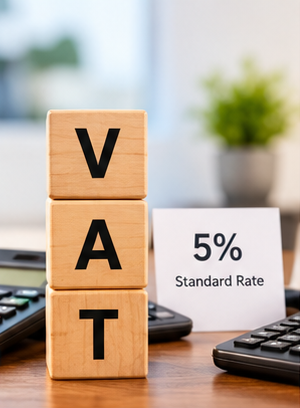
Suppose, if any taxable product has a price of AED 1,000 before VAT. A 5% of VAT charge will add AED 50 which makes the price AED 1,050 assuming the supply is the subject to the standard rate.
VAT is applicable on different sectors such as retail, professional services, hospitality, food, transactions of real estate and other commercial activities. However, many supplies may have zero or exempt under the VAT rules of UAE.
Does Every Business Require VAT Registration?
You should know that every business does not require to register VAT immediately.
For the residents of UAE who are doing businesses, VAT registration is mandatory when the value of their taxable supplies and imports exceeds from AED 375,000 over the previous 12 months or expected to exceed within the next 30 days.
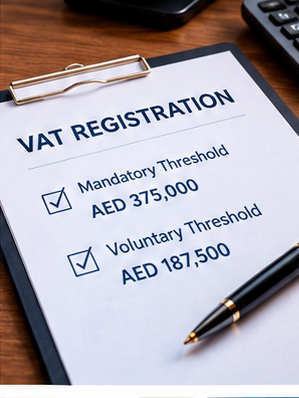
The businesses that are below the mandatory threshold are eligible for voluntary registration. It means when their taxable supplies or imports exceeds by AED 187,500 are subject to the applicable rules.
The businesses that are running by the non-residents of UAE have different requirements for registration. Under certain circumstances, a non-resident who are making taxable supplies in UAE are required to register regardless of the normal AED 375,000 threshold of no other UAE person is responsible for accounting for the VAT.
What is Corporate Tax in UAE?
Corporate Tax is yet another important addition in the UAE modern tax framework.
The UAE Corporate Tax regime mainly applies to the financial years beginning on or after 1st June, 2023. According to the standard regime, the taxable income up to AED 375,000 is subject to 0% rate. If the income exceeds from AED 375,000 is generally subject to 9% corporate tax rate.

It is essential to understand that 9% rate is applied to taxable income not to a total sales or turnover of the company.
A company’s accounting profit may need adjustments under UAE Corporate Tax legislation to determine its taxable income. Consequently, business owners should not simply calculate 9% of their annual revenue.
Who can be the Subject to Corporate Tax?
Corporate Tax can be applied to UAE companies or other entities who are conducting business activities. However, certain entities and activities may receive exemptions under the law. The Ministry of Finance can identify the categories which include certain government entities, qualifying public benefit entities, investment funds and certain natural resource business are applicable.
So, it is essential for the companies to determine their specific corporate tax instead of assuming tha every business will be taxed in the same way.
What is the Corporate Tax for Individuals and Freelancers?
With the introduction of Corporate tax, freelancers, consultants, sole proprietors are raising the questions.
You should know that a natural person becomes subject to UAE Corporate Tax when they conduct a Business or Business Activity in the UAE and their total turnover from those activities exceeds AED 1 million during a Gregorian calendar year.
According to FTA, the certain income streams are not considered as business or business activities which include wages, personal investment income and the income from real estate investment.
It means an employee who is receiving a salary should not confuse employment income with business turnover.
The individuals who are operating commercial activities or freelancers should examine their circumstances carefully. If their turnover of annual business approaches or exceeds AED 1 million then they are eligible for tax.
What is Excise Tax?
Excise Tax is considered as another type of UAE tax. It is focused on specific categories of goods unlike the VAT.
This system has been designed in part to regulate goods which are considered harmful to health or the environment and to encourage more responsible consumption.

According to current FTA guidance, the products such as tobacco and tobacco products, electronic smoking devices and related liquids as well as energy drinks among the excise goods subject to a 100% rate.
The rules for excise tax can change or differ significantly on various product categories, manufacturers, importers, distributors as well as retailers. So, you should check the applicable classifications and calculation methods.
What is Custom Duties?
Businesses who are importing goods in UAE may encounter custom duties and import related procedures.
However, custom treatment can depend on different factors such as goods, their origin, destination, custom rules etc.

The companies who are involved in international trade should understand the custom requirements. The overall cost of importing products not determined by the VAT only.
It is essential for the businesses to consider custom duties, VAT, expense of shipping, documentation and other applicable charges.
What is UAE Tax on Tourism?
When any visitors book hotels or use hospitality services in Dubai may notice some additional charges.

According to UAE Government, the restaurants, hotels, resorts have different taxes, fee as well as service related charges. However, it depends on the emirates and establishment, Dubai has Tourism Dirham fee for staying in hotel. The amount will depend on the hotel category. These are different from personal income tax and must not be confused with VAT or Corporate Tax.
Why Understanding UAE Tax Matters?
You should know that the tax environment has developed in UAE in recent years. However, the country does poses personal income tax for individuals but businesses comes under structured federal ax framework.
VAT can affect the every day purchases as well as commercial transactions. Mainly, corporate tax applies to the businesses who are qualifying the taxable income under the relevant rules. Excise tax is applicable on specific goods.
Entrepreneurs and investors should understand these rules which will help them in budgeting, pricing, accounting, compliance as well as structuring the business.
Tax rules are quite complex. The international businesses, freelancers, companies, property related activities operating across multiple jurisdictions can have different ibligations.
Final Thoughts
The UAE tax system combines a relatively low-rate Corporate Tax regime with VAT and targeted taxes such as Excise Tax. Individuals generally do not pay UAE personal income tax on their salaries, while businesses may have Corporate Tax and VAT obligations depending on their activities and circumstances.
For businesses, some of the most important figures to remember are the 5% standard VAT rate, the AED 375,000 VAT mandatory registration threshold, the AED 187,500 voluntary VAT registration threshold, and the 0%/9% Corporate Tax structure around AED 375,000 of taxable income.
Anyone starting a business, freelancing, investing, or expanding into the UAE should check the latest Federal Tax Authority and Ministry of Finance guidance because tax legislation and administrative requirements can change. For complex situations, professional tax advice can help ensure that the correct registration, reporting, and payment obligations are met.